“Dan is the best value expert I have ever worked with. He changed the game for how we collect metrics and turn them into an effective and professional business case that we could use repeatably.”
For B2B SaaS and tech teams selling complex deals to economic buyers.
0
0
0
Great. Your rep did their job. Now your champion has to convince the people who control the budget.
Yes, they loved the product, but can they explain why it’s worth the money and effort… to executives who don’t?
Most champions have never been taught how to sell internally. That’s why promising deals stall, discount, or quietly disappear.
Complex solutions where the economic buyer and the end user are not the same person.
Responsible for win rates and late-stage conversion with no easy levers left to pull.
Moving into enterprise deals for the first time and losing too many to the status quo.
Multiple stakeholders, split decisions, and a CFO who needs a financial case before anything moves.
First, your reps learn to identify which business outcomes your product drives and why each one belongs in the value case.
Map the project, the organization, its systems, and strategy
Define clear objectives, as well as metrics to measure progress
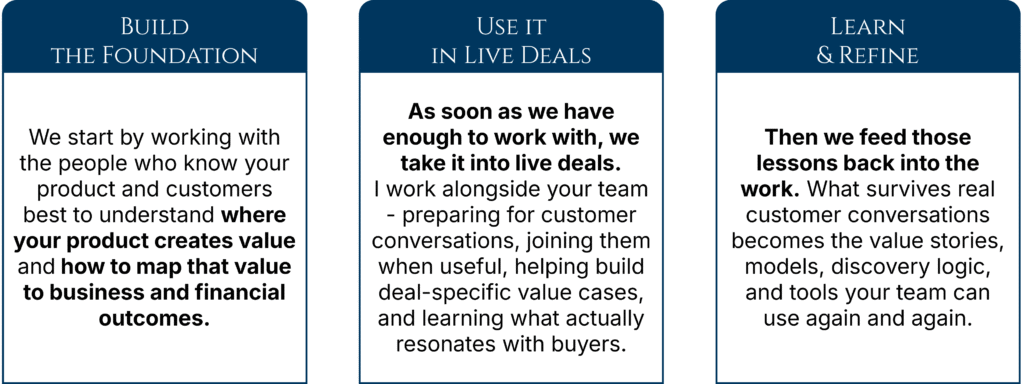
We start building the foundation immediately and begin applying it to real opportunities as soon as there’s enough to work with (usually 2-3 weeks). A typical engagement lasts 3 months.
You’re getting hands-on collaboration, not consulting theater (we won’t spend entire afternoons moving Post-its around a conference room).
I’ll need focused time upfront from the people who know your product and sales motion — typically 2–3 hours a week for the first 2–3 weeks. After that, we’ll mostly touch base to review and refine what we’re building.
I’ll also work directly with relevant reps, coaching them and working alongside them on live opportunities. But this should feel more like having another member of the team, with regular back-and-forth, than a formal cadence of meetings and deliverables. The goal is to fit into your existing sales rhythm, not add another layer to it.
We won’t build a theoretical model in a conference room and hand it to your reps. This will be built with them, not for them. By the time our engagement ends, your reps won’t have just been trained on a new methodology – they’ll have seen it take shape and used it in their own deals.
In a typical three-month engagement, it may not be possible to work hands-on with every rep, especially on a larger team. But by then, we’ll have an approach that has been tested and refined in real deals, with real reps – and hopefully with some wins and internal advocates to help build credibility with the rest of the team. From there, we can roll it out more broadly through training and enablement and additional coaching, or extend the engagement to work directly with more reps. Three months is a typical starting point, not a hard limit.
You’re off to a great start! ROI calculators can be a very useful way to start the value conversation. But they rarely capture the full value of a product or the full cost and effort required to change.
Your buyer isn’t just asking, “Is the ROI positive?” They’re deciding whether the upside is worth the money, effort, risk, and disruption of doing something differently.
That’s why my goal isn’t to teach your reps which numbers to collect and where to plug them into a spreadsheet. It’s to help them understand and articulate your value — where it comes from, how to uncover it with the customer, and how to quantify it credibly.